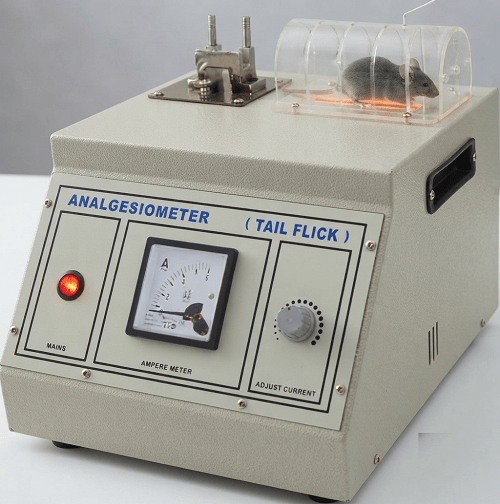
An analgesiometer is a specialized laboratory instrument used in pharmacology and pain research to measure pain thresholds and evaluate the effectiveness of pain-relieving (analgesic) drugs on small test animals like rats and mice.
Main Types of Analgesiometers
- Tail-Flick Analgesiometer: Uses a focused light beam, halogen lamp, or heated wire directed at the rodent’s tail. It measures the latency time (in seconds) it takes for the animal to flick its tail away from the heat.
- Hot Plate Analgesiometer (Eddy’s Hot Plate): Features a temperature-controlled metal surface (usually kept between 30°C and 80°C) surrounded by a clear enclosure. It measures how long it takes for the animal to show a pain response, such as licking its paws or jumping.
- Mechanical Analgesiometers: Uses tools like Von Frey filaments or pressure devices (Randall-Selitto test) to measure reactions to physical force rather than heat.
How the Test Works
- Baseline Measurement: The normal reaction time of the untreated animal is recorded.
- Drug Administration: An analgesic drug (like morphine) is given to the animal.
- Post-Treatment Measurement: The test is repeated after a set time.
- Evaluation: If the animal takes longer to react to the heat or pressure than it did originally, the drug is proven to have pain-relieving properties.
- Safety Cut-Off: A strict time limit (such as 10 to 12 seconds for tail-flick tests) is enforced so the heat does not damage the animal’s tissue.