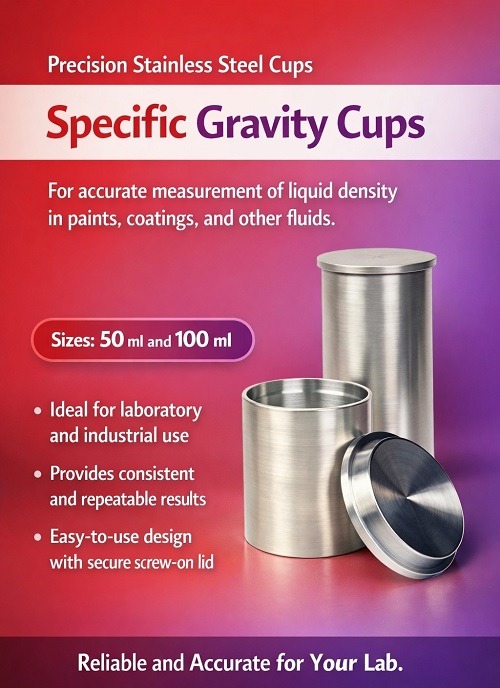

Technical Specification Sheet: Precision Stainless Steel Specific Gravity Cups
1. Product Overview
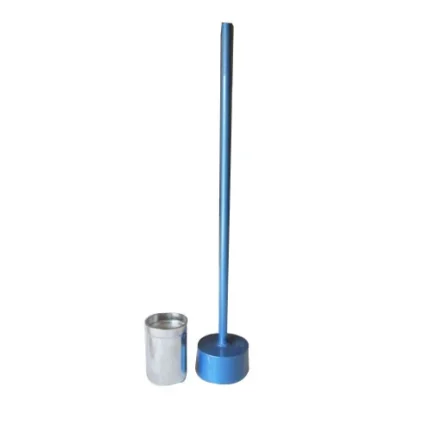
The Precision Stainless Steel Specific Gravity Cups (also known as Pycnometers or Density Cups) are designed for the highly accurate measurement of liquid density, specific gravity, and volume-per-unit weight of various fluids.
2. Technical Specifications
| Parameter | Specification Details |
| Product Type | Specific Gravity Cups / Pycnometers |
| Material of Construction | High-grade Precision Stainless Steel |
| Available Nominal Volumes | 50 ml and 100 ml |
| Closure Type | Secure, precision-fit screw-on lid |
| Application Suitability | Paints, coatings, lacquers, inks, and other viscous or non-viscous fluids |
| Operating Environment | Laboratory and industrial testing environments |
3. Key Features & Performance
-
High Precision Material: Manufactured from durable, corrosion-resistant stainless steel to ensure longevity and resist degradation from chemical exposure.
-
Consistent Results: Engineered to deliver repeatable, uniform, and reliable density measurements across testing batches.
-
Secure Sealing: Equipped with an easy-to-use, finely threaded screw-on lid to minimize sample evaporation, spillage, or air pocket interference during testing.
-
Versatile Industry Application: Optimally suited for quality control laboratories in the paint, chemical processing, and coating manufacturing industries.
4. Standard Operating Procedure (Brief Guide)
-
Tare: Clean, dry, and weigh the empty specific gravity cup and lid on an analytical balance to record the tare weight.
-
Fill: Fill the cup with the liquid sample (e.g., paint or coating material) slightly below the brim.
-
Seal: Securely screw on the lid. Excess liquid should displace through the overflow orifice (if applicable) to ensure an exact fixed volume.
-
Clean & Weigh: Wipe away any overflow from the exterior surfaces of the cup and re-weigh the filled assembly.
-
Calculate: Subtract the tare weight from the filled weight to determine the net fluid mass, then divide by the nominal volume (50 ml or 100 ml) to calculate the density.